ML1401 - Grades on the curve of life that is 2025
David and Matt review 2025 as abstractly and unhelpfully as possible.
“r/(1-r)” is the ratio of your savings (“r”) to your spending (“1-r”, or 100% of your income minus savings). Messing with the value of r reveals a potent mathematical reality: every extra dollar you save raises your financial stability more than the last because it increases your total savings (r) AND reduces the amount your savings cover (1-r).
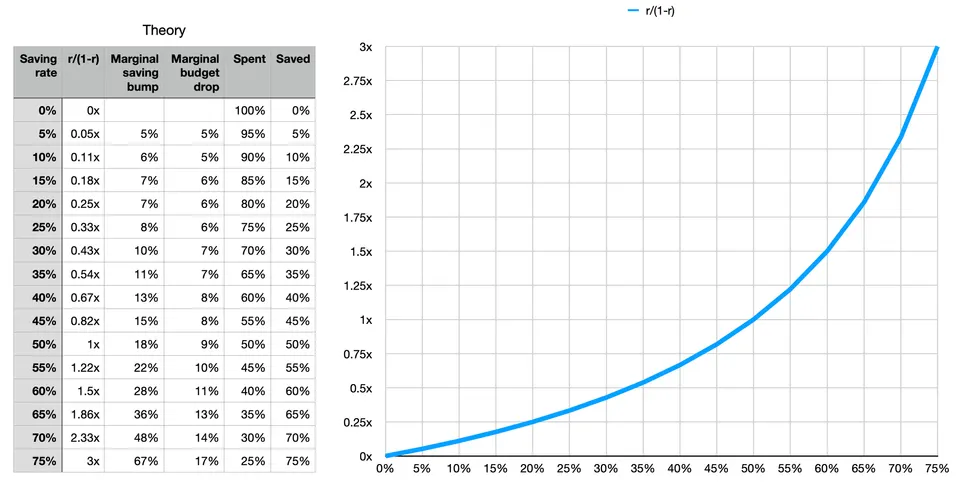
The blue line above shows this. The x-axis is how much you’re saving, and the y-axis is the ratio of savings-to-spending. At 5% savings, you save (roughly) 1/20th of what you spend, meaning it’ll take (roughly) 20 years to save a year’s spending (this is not a great retirement strategy). In most people’s intuitions, doubling that to 10% should make the ratio to 1/10, but those extra savings made the first 5% you saved proportionally larger, so instead it’s 1/9, and the time to save a year’s spending becomes 9 years instead of the expected 10. This effect compounds with alarming speed. By the time you’re saving 30%, every extra dollar you save has the same effect as saving two dollars from scratch; by 60%, it’s over five. Saving 50% instead of 25% doesn’t double your pace to retirement: it triples it (and that’s entirely discounting compound interest which rewards early, aggressive saving strategies).
It is true that every dollar you save also hurts your budget more than the last: taking away a dollar when you have 50 hurts more than when you have 100. But because of how the math works, reducing your budget doesn’t hurt anywhere near as much as it helps your savings proportionally. At 50% savings, each extra dollar you shave off is two times as tough on your budget, and four times as helpful for your retirement. And that ratio only widens as you tighten your belt further.
What you take from all this—crossed with the realities of living life and your own sanity—is up to you.